
Subscribe to continue reading
Become a paid subscriber to get access to the rest of this post and other exclusive content.
Become a paid subscriber to get access to the rest of this post and other exclusive content.
There is much discussion about whether AI programs should be called conscious. Most of us believe that there is a fundamental difference between human intelligence and that of machines: no matter how good an AI program becomes at showing behavior that suggests that it is conscious, the program is not conscious.
On the other hand…
(more…)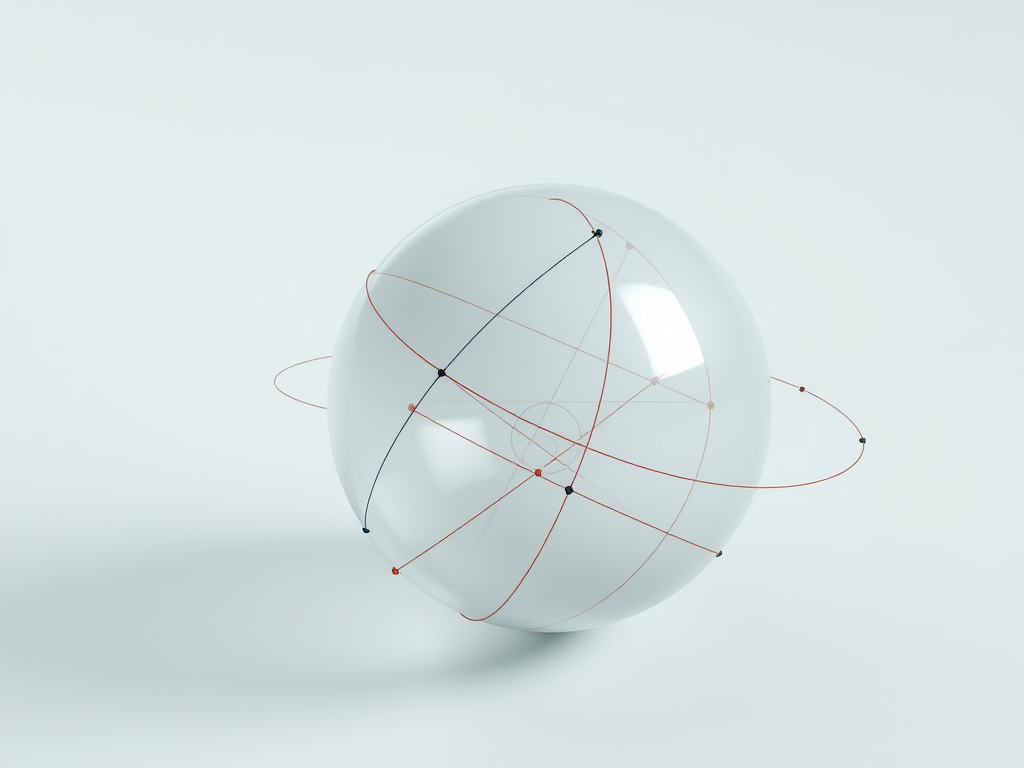

Today I started a lecture series about Einstein’s relativity theories. I started explaining things about basic geometry, so we talked about the postulate of the parallels first described by Euclid of Alexandria: if you draw a straight line on a piece of paper (l in the image on the right) and a point (p in the image) next to it, then there can be only one straight line through this point which does not intersect the line we started with (the dashed line) – there is only one parallel.
(more…)
Recently I visited a conference at the university of Delft dedicated to quantum technology and philosophy. Among physicists working with quantum information, it has become more and more fashionable in the past few decades to say that information is physical. Is that a sensible claim?
(more…)Some time ago I have given a “pub lecture” (the lecture was both public and in a pub) about Einstein, Newton and relativity. Below is an abstract of the lecture.
(more…)(more…)I’ve written a paper in which I put into perspective the media catchphrase “time does not exist”. Below you’ll find the introduction to my paper and a link to the whole thing. Enjoy!
When I started writing this blogpost a week ago, I wrote this: “When times are as difficult and unpredictable as they are today, I find comfort in mathematics. No matter how things turn out, how many more difficulties come our way, we may be certain that mathematics stays the way it is* – it is our indestructable beacon of rationality. In this blogpost I want to share with you some of the comfort that mathematics gives to me.”
But the longer I think about these things, the more I realise that it is not this comfort that I want to share. I realise that when I am at home alone, sitting in my ‘internest’, writing this blog, I forget about all the trouble around me. I stop worrying about the coronavirus or about my recent divorce. Mathematics makes me happy, that’s what I want to share!

Just like me, the followers of Pythagoras in the sixth century BC really loved their numbers. When one of them discovered that there are numbers, like √2, which you can’t write out in all their decimals, because they have infinitely many of them (√2=1.41421356237…), the other Pythagoreans threw the poor fellow into the sea. But his death hasn’t helped. Numbers with infinitely many decimals exist, and √2 is one of them.
To prove that √2 has infinitely many decimals, we must show that it can’t be written as the division of two whole numbers – that √2 is an irrational number (so-called because it is not the ratio between two whole numbers).
If mathematical proof isn’t your favourite pass-time (not even in quarantine) then perhaps you should skip to the paragraph ‘Hamlet’s nutshell’.
The proof that √2 is an irrational number is a proof by contradiction. We assume that the opposite of what we want to prove, the statement “√2 is the ratio between two whole numbers”, is true, and from that we derive a contradiction, so that we know that the assumption that we started with is false.
So we start with the assumption that √2 is the ratio between two whole numbers. Let’s begin by writing the ratio in terms of its smallest divisors, the lowest values of m and n for which the ratio stays the same (so that 3/6 becomes 1/2, 5/15 becomes 1/3 and 2/1200 becomes 1/600). Let’s call these smallest divisors m and n. To derive the contradiction that we need for our proof, we will show that the m and the n that go into √2 are even numbers, which means that $\frac{m}{n}$ is not the ratio between two smallest divisors (because both terms in the ratio can be divided by two). But the assumption that we started with is that m and n are the smallest divisors, so if our reasoning is correct, our starting assumption must be wrong.
Let’s begin with this:
$\sqrt{2}=\frac{m}{n}$
square both sides to get
$2 = \left( \frac{m}{n} \right)^2 = \frac{m^2}{n^2}$
then multiply both sides by $n^2$ to get
$2n^2=m^2$
If m and n are arbitrary whole numbers, then so are $m^2$ and $n^2$. So if $n^2$ is equal to some arbitrary whole number multiplied by two, $m^2$ must be an even number (because any number multiplied by 2 is an even number). Ok, so we know that $m^2$ is even, but what about m? Is m also even, if $m^2$ is even? m appears in our equation in its squared form, but whatever the value of $m^2$, there are only two possibilities: m is either even or odd (mathematicians like stating the obvious). But how does that help us? How can we explore these two possibilities?
We’re going to use a little trick here: we know that a number is an even number if it can be divided by 2, so if m is an even number, we may write $m=2k$, where k is again some arbitrary number. Think about it. If some arbitrary number is one of these “1, 2, 3, 4, 5…” then two times that number is in the list “2, 4, 6, 8…”. This gives us a list of even numbers, but how do we get to the odd numbers? The second part of our trick is to add 1 to every number in the list of even numbers, so that we get a list with odd numbers (“3, 5, 7, 9…”), so we know that we can write any odd number as $2k+1$. Try it yourself, fill in “1, 2, 3, 4, 5…” for k in $2k+1$ and you get “3, 5, 7, 9…”.
Back to our two possibilities. We know that $m^2$ is even, but what about m? Is m even or odd? Where do these possibilities lead us?
Case 1) If m is even, we know that $m=2k$ for an arbitrary k, so that $m^2= \left( 2k \right)^2=4k^2$, which is again an even number because it is divisible by two. We now know that $\sqrt{2}=\frac{m}{n}$ is consistent with $m^2$ and m being both even.
Case 2) If m is odd, then we may write $m=2k+1$ for some arbitrary number k, so that $m^2= \left( 2k + 1 \right) \left( 2k+1 \right) = 4k^2 + 4k+1$. This expression has the form “even number + 1”, because $4k^2 + 4k$ is even, so $4k^2 + 4k+1$ must be odd. We see that the second possibility leads to saying “if m is odd, then $m^2$ is also odd.”
Before we started talking about the two possibilities, we asked “what can we say about m if we know that $m^2$ is even?” We see that assuming that m is odd leads to an $m^2$ which is odd, so possibility 2 is not a possibility at all! The only remaining option is possibility 1: if $m^2$ is even, then m is also even.
Are we there yet? We started this blogpost by saying that it is impossible that $\sqrt{2}=\frac{m}{n}$ if m and n are smallest divisors because $\sqrt{2}=\frac{m}{n}$ implies that m and n are even, but we haven’t shown that yet. We know that from $m^2 = 2n^2$ it follows that both m and $m^2$ are even, but what about n? Let’s use our ‘little trick’ again. Since we know that m is an even number, we may write $m = 2k$. We also know that $m^2=2n^2$, which gives us $4k^2=2n^2$. Divide both sides by 2, and we see that $2k^2=n^2$, which tells us that $n^2$ is an even number. We know from our earlier reasoning that if the square of an arbitrary number is even, then so is the number itself (if $m^2$ is even then m is even). We just showed that $n^2$ is even, so n itself must also be even.
Phiew! We have finally reached the contradiction. Both m and n are even, so they are not the smallest divisors in $\sqrt{2}=\frac{m}{n}$. This contradicts our starting assumption, so that assumption must be false, so √2 is not a rational number.
Q.E.D.**
Something keeps nagging, though. We have shown that both m and n are even, which tells us that m and n are not the smallest divisors in $\sqrt{2}=\frac{m}{n}$, but what does that tell us? We assumed that they were smallest divisors, and that’s why there was a contradiction. What if we don’t make this assumption? What if we assume that there are numbers m and n such that $\sqrt{2}=\frac{m}{n}$, for some m and n that are not the smallest divisors in $\frac{m}{n}$?
What we should realise is that both m and n could be any number, so if we say $\sqrt{2}=\frac{m}{n}$, then this equation must hold for all choices of m and n, including the choice where m and n are smallest divisors. m and n being the smallest divisors is not an extra assumption – it is part of the assumption that m and n are arbitrary numbers.
Can’t we make a claim about √2 that is a bit weaker? What if we say that m and n are numbers for which $\sqrt{2}=\frac{m}{n}$ does not have smallest divisors? Will that allow us to say that √2 is a ratio between whole numbers?
Nice try, but it won’t work. Or rather, it works, but then the m and n that go into √2 are not numbers as we know them. Take any pair of positive, whole numbers, and make a rational number out of them $\left(\frac{m}{n}\right)$. Depending on the choice you make, it is either possible to divide both n and m by some other number (so that, for example, $\frac{3}{6}$ becomes $\frac{1}{2}$, and $\frac{4}{16}$ becomes $\frac{1}{4}$) or you can’t do that, in which case you have the smallest divisors ($\frac{1}{2}$, $\frac{5}{8}$, $\frac{6}{7}$). The possibility left for m and n that neither have nor are smallest divisors of √2, is to choose for m and n some trans-finite numbers, such as $\aleph_0$, which represents, among other things, the cardinality of the set of all integers. But the moment we start talking about trans-finite numbers, we leave the realm of the real and the rational numbers. The ratio which trans-finite numbers can give us is not a rational number.
It makes me a bit dizzy when I start thinking about trans-finite numbers (if you’ve skipped the proof, just believe me when I say that trans-finite numbers are stranger than fiction). Math-induced dizziness is a pleasant dizziness, much as that due to a glass of whisky. It reminds me of something that Shakespeare’s Hamlet says:
“I could be bounded in a nutshell, and count myself a king of infinite space”
No matter what happens, no matter what comes our way or how isolated I become, in my mind I can instantly travel to the farthest reaches of human understanding. Simply by following the rules of logic.
*) which is not to say that it’s impossible that mathematicians discover new theorems or new mathematical relations. What I mean is that mathematics, as logical reasoning about numbers, will continue, no matter what.
**) Nerd-speak for ‘I told you so’. Also sometimes “quod erat demonstrandum” (Latin for ‘…which needed to be proved’)
It is often said that in mathematical equations, such as ‘2+2=4’, the symbol ‘=’ represents the fact that on both sides of the equation there is the same thing. That’s wrong: on the one side there are three symbols, while on the other there is just one.

Even in the equation ‘1=1’ the same-thing-on-both-sides-reading is wrong, because there there are two separate things (the ‘1’ on the left and the ‘1’ on the right).
So how should we understand the ‘=’-symbol? It might seem reasonable to say that in the equation ‘2+2=4’ we should read ‘=’ as meaning that the things that the numbers refer to are the same (in number). If the numbers in the equation refer to apples, for example, then the equation merely states that if you add two apples to two apples you end up with four apples. The ‘=’-symbol tells you that two apples added to two apples is the same as four apples.
But this view is problematic. Mathematics is usually understood as a language or formalism that is independent of reality. Mathematics is, to put it disrespectfully, merely a bunch of tautologies, whose truth depends on the definitions that we ourselves choose. We can of course apply mathematical language/formalism to things we see, but then we are no longer doing mathematics – we’ve turned into physicists.
We can’t just say that the number of apples referred to by the symbols are the same, because mathematical terms have no meaning outside of mathematics.
so what is “=”?
 Unlock with Patreon