Non-Euclidean Geometry

Today I started a lecture series about Einstein’s relativity theories. I started explaining things about basic geometry, so we talked about the postulate of the parallels first described by Euclid of Alexandria: if you draw a straight line on a piece of paper (l in the image on the right) and a point (p in the image) next to it, then there can be only one straight line through this point which does not intersect the line we started with (the dashed line) – there is only one parallel.
For centuries after Euclid, mathematicians tried to derive this postulate from more basic definitions and postulates in Euclid’s work, but they failed. It was not until the $18^{th}$ century when several mathematicatians – independently from each other – started investigating the possibility of assuming that the postulate does not hold. From the alternative assumption – it is not true that through a point next to a straight line only one parallel can be drawn – was born the idea non-euclidean geometries: it is possible to mathematically describe geometrical spaces in which the parallel-postulate does not hold.
Different types of geometry

Besides the traditonal Euclidean geometry, which describes a flat space in which the parallel-postulate holds, there are different possible types of geometry. In the image on the right we see elliptic geometry (which describes the surface of a sphere) and hyperbolic geometry (‘saddle-geometry’). Different types of geometry differ from Euclidean geometry in more than one way: the angles inside a triangle do not add up to 180 degrees, while the circumference of a circle is not equal to $2\pi r$
So what about the parallels in these different types of geometries? How many parallels are there through a point which lies next to a straight line? That is a difficult question, because the notion of ‘straight line’ is different in the different geometries. To see how it works, we take a look at the surface of a sphere.

Great Circles and Straight Lines
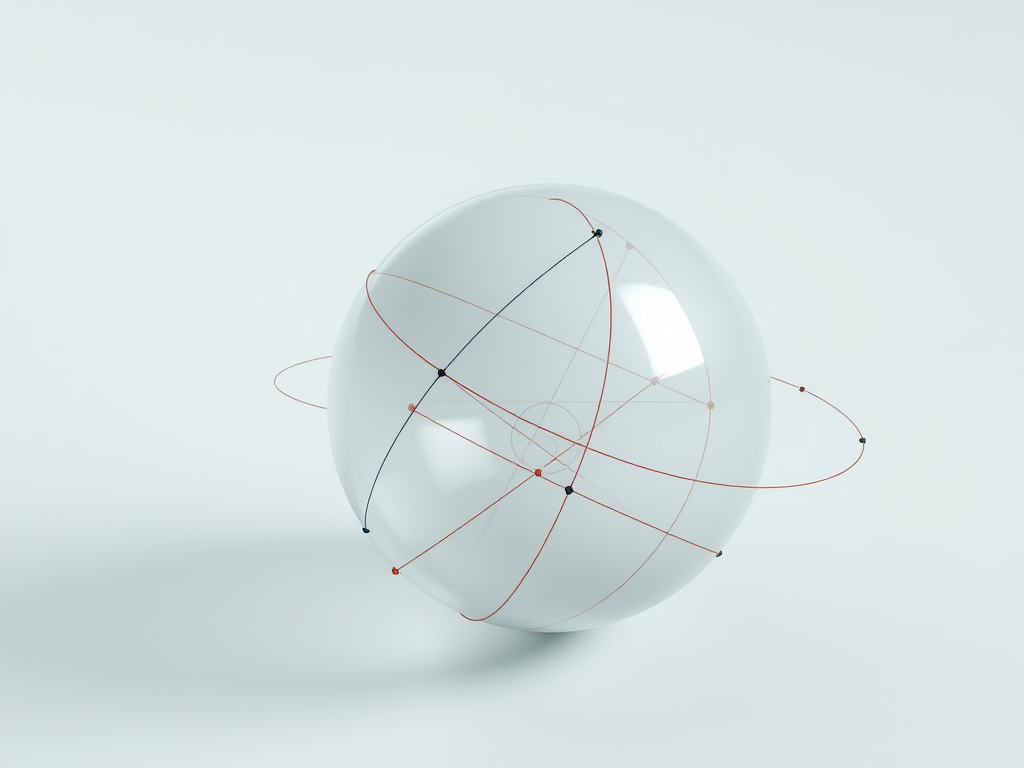
A straight line on the surface of a sphere is always a part of a great circle, which is the largest possible circle which can be drawn on the surface of a sphere (hence the name). On the sphere of the Earth, examples of great circles are the equator and any circle that goes over both the North and the South Pole (any one of the tropics is not a great circle, as its length is shorter than that of the equator).Why do we say that the equator is a straight line while any of the tropics his not a straight line? Let’s take a step back to answer that question.
How do we characterize a straight line in flat Euclidean geometry? A straight line in is the shortest distance between two points. If you start out from some point A and reach some other point B without ever changing the direction in which you walk, you will have walked the shortest distance between A and B.

Suppose you are at Earth’s North Pole, and you start walking for a very long time without ever changing direction. Any of the directions that you can choose will lead you from the North Pole to the South Pole. Try to imagine this: any other path, which would be a smaller circle, would require you to change direction to stay on the path. And that goes the other way as well: if you start walking from the South Pole without ever changing direction, you will always end up at the North Pole. This argument can be extended to any point on the sphere. If you start walking in a random direction without ever changing your course, you will end up in a socalled antipodal point, which is exactly the opposite point with respect to the center of the Earth (like Spain and New Zealand in the image on the right).
The Shortest Path is a Segment of a Great Circle

We saw earlier that the shortest path between two points is one on which you do not change direction, and we see now that any path on which the direction does not change is necessarily a great circle (or a part of one), so we may conclude that any shortest path must be part of a great circle. This will help you understand why a flight between Amsterdam and New York looks like an arc on a map.
Not only two-dimensional space (like the curved surface of a sphere) can be curved instead of flat. Read this blogpost to understand how three dimensional space, too, may be curved and how that helps us to understand Einstein’s idea about gravity.

Leave a Reply